
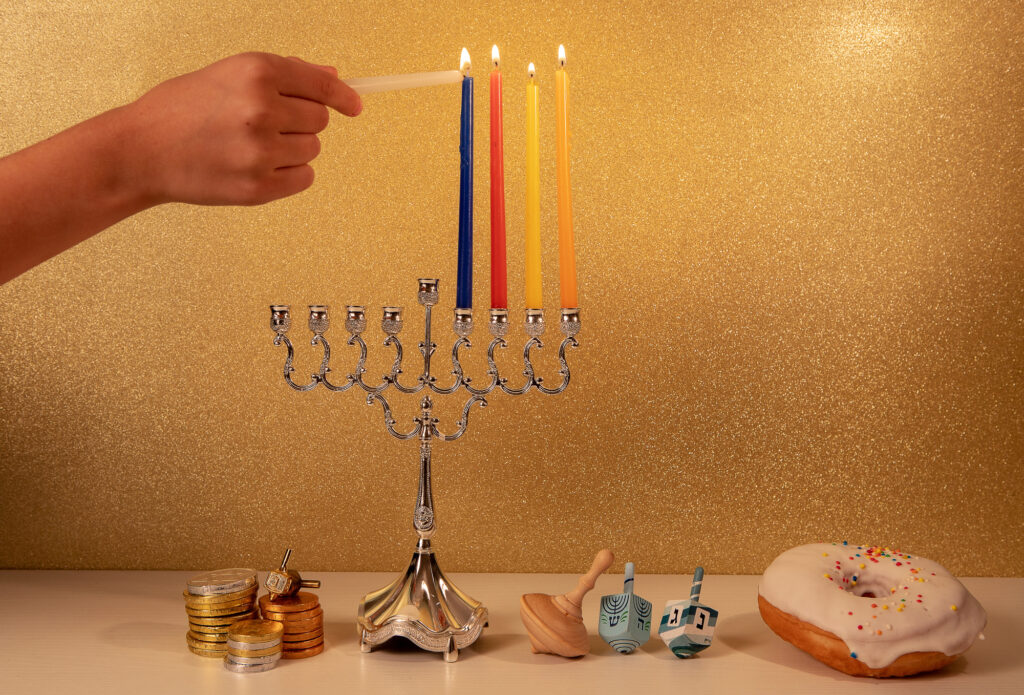
 A Secular Appreciation of Hanukkah for Gay Men: Light, Repair, and the Courage to Be Seen
 A Secular Appreciation of Hanukkah for Gay Men: Light, Repair, and the Courage to Be Seen
By Ken Howard, LCSW, CST
Gay men’s specialist psychotherapist (CA) and coach (worldwide)
Hanukkah is often framed as a religious holiday, but like Christmas, Easter, or Yom Kippur, it can also be understood secularly—as a psychological, cultural, and ethical practice rather than a statement of belief.
At its core, Hanukkah is about light. Not spectacle. Not dominance. Not moral superiority. Just light—introduced deliberately, patiently, and publicly into a darker season.
I’ve written before about secular ways of appreciating holidays that many gay men have complicated relationships with—Christmas, Easter, and Yom Kippur among them. Hanukkah belongs in that same lineage. And for gay men in particular, it offers something quietly radical:
the idea that light only matters if it’s visible.
Hanukkah beyond miracles: dedication, light, and repair
Historically, Hanukkah commemorates the rededication of the Temple after a period of cultural suppression. Whether or not one takes the miracle-of-the-oil story literally, the symbolic message endures: what is worth preserving must be actively tended.
In secular terms, Hanukkah points to three enduring human themes:
-
Dedication – choosing, again and again, what matters
-
Continuity – protecting identity under pressure to assimilate
-
Visibility – allowing light to be seen rather than hidden
But there is another Jewish concept that deepens this understanding—and it translates beautifully into secular life.
Tikkun olam: repairing the world by adding light
In Jewish ethics, tikkun olam refers to the responsibility to repair the world—not through grand gestures, but through accumulated acts of care, justice, and presence.
You don’t have to be religious to recognize this principle. It’s a profoundly humanistic idea:
that the world is not fixed, that harm is not inevitable, and that individuals—especially those who have known suffering—carry a particular wisdom about how to reduce it.
For me, this idea has always resonated deeply, especially in the context of my early work in HIV/AIDS mental health. At a time when gay men were dying in staggering numbers—often ignored, stigmatized, or politicized—“repairing the world” didn’t look abstract. It looked like sitting with grief. Advocating for dignity. Helping men make meaning when the future was uncertain.
That ethic has never left me.
Today, my work looks different, but the throughline is the same: supporting a global community of gay men—helping them live with more honesty, less shame, and greater agency in their relationships, sexuality, aging, and purpose.
That, too, is tikkun olam.
Light as a public responsibility
One of the lesser-known aspects of Hanukkah is that the menorah is traditionally placed where it can be seen—near a window, or at the threshold between private and public space.
This is not accidental.
There’s a long cultural argument about light that crosses religious and secular lines alike:
-
George H. W. Bush’s phrase “a thousand points of light”, whatever one thought of his politics, captured the idea that social good rarely comes from a single source of authority—it comes from distributed, local acts of care.
-
In Godspell, the song “You Are the Light of the World” carries a line borrowed from the Gospel of Matthew: light hidden under a bushel basket loses its purpose.
-
Even in purely secular psychology, we understand that unexpressed strengths wither, while expressed values organize a life.
The message is consistent:
light that is hidden helps no one—not even the person holding it.
Why this matters so much for gay men
Gay men are often trained—explicitly or implicitly—to dim themselves:
-
Be successful, but not threatening
-
Be confident, but not “too much”
-
Be sexual, but not inconvenient
-
Be visible, but not disruptive
Many of us learned early that safety came from containment. That adaptation made sense at the time. But over decades, it can quietly hollow a life out.
Hanukkah offers a counter-message that feels especially relevant in midlife and beyond:
You don’t have to flood the room with light.
You just have to stop hiding the flame you already have.
And you don’t light all eight candles at once. You build.
A secular Hanukkah practice: light as repair
Here’s a way to work with Hanukkah—religious or not—as a practice of tikkun olam, starting with yourself and extending outward:
Night 1: One light
What truth about yourself are you done minimizing?
Night 2: Rededication
What value are you recommitting to—health, intimacy, integrity, calm?
Night 3: Repair
Where is repair possible: a relationship, a conversation, an overdue boundary?
Night 4: Releasing inherited shame
What belief about yourself no longer deserves authority?
Night 5: Community
Who are you actively contributing to—not just consuming?
Night 6: Stewardship
How are you caring for your energy, body, attention, and time?
Night 7: Visibility
Where are you ready to be seen more honestly?
Night 8: Repair beyond yourself
What small act makes the world—your corner of it—more humane?
This is not self-improvement. It’s ethical presence.
Hanukkah in a complicated December
For many gay men, December is emotionally loaded: family estrangement, comparison, loneliness, unresolved grief, or the pressure to appear “fine.”
Hanukkah doesn’t ask for cheer.
It asks for continuity.
One more night.
One more light.
One more reason not to disappear.
If this resonates—and you want support
If themes of visibility, repair, identity, aging, or purpose are stirring something personal for you, you don’t have to sort it out alone.
I work with gay men who are thoughtful, accomplished, and often quietly exhausted from carrying too much without adequate support.
-
Psychotherapy (California): anxiety, depression, trauma, relationships, sexuality, identity, and life transitions
-
Coaching (worldwide): direction, confidence, dating and relationship strategy, and building a life that feels coherent and lived-from-the-inside
You can reach me at 310-339-5778 or Ken@GayTherapyLA.com
.
And as a secular Hanukkah wish—rooted not in belief, but in ethics:
May you stop hiding the light you earned by surviving.
May you use it to repair, not perform.
May your presence make the world—quietly, steadily—more livable.